Beyond the Basics: What Nonprofit Expense Categories Actually Depend On
Table of Contents
- The Three Functional Expense Categories
- Allowable Expenses for Nonprofit Organizations
- Categories vs. Structure: Why Your Nonprofit Expense Categories Still Feel Messy
- Embed Your Expense Categorization Within a Fund Accounting Structure
- Strong Expense Category Management Starts with Data Health
- A Practical Expense Category Health Check
- How Blackbaud Financial Edge NXT® Helps You Manage Expense Categories
- Your Categories Are Only as Strong as the Structure Behind Them
If you run finance for a nonprofit, you already know the three functional buckets the IRS wants your expenses sorted into. That’s rarely the issue. Problems arise when the categories look right on the page but the account structure underneath them is inconsistent.
Expense categories are only as useful as the chart of accounts, fund structure, and coding standards that support them. When those pieces work together, reporting becomes easier, audits become less stressful, and finance teams spend less time cleaning up data. When they don’t, even simple reports can become difficult to trust.
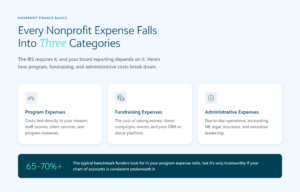
Nonprofit expense categories (also called nonprofit budget categories) are the groupings your organization uses to classify how money is spent. The IRS requires most tax-exempt organizations to sort expenses into three functional categories on Form 990, and those same categories typically drive your internal budgeting and board reporting, too.
PROGRAM EXPENSES
Program expenses are the costs directly tied to delivering your mission, such as program staff salaries, direct client services, educational materials, and travel to program sites. For many nonprofit organizations, program expenses make up the largest expense category, and funders often look closely at how those costs are categorized.
FUNDRAISING EXPENSES
Fundraising expenses cover the cost of raising money, including donor campaigns, events, your CRM or donor management platform, and development staff salaries. These costs are necessary to sustain your organization, but donors and watchdog groups scrutinize them closely, so accurate tracking matters.
MANAGEMENT AND GENERAL (ADMINISTRATIVE) EXPENSES
Administrative expenses, sometimes called management and general expenses, keep the organization running day to day. Think accounting, HR, legal, insurance, and executive leadership. They’re not tied to a specific program or fundraising campaign, which is exactly why they’re easy to mis-categorize.
FUNCTIONAL VS. NATURAL EXPENSE CATEGORIES
Every expense your nonprofit incurs has two identities. A natural classification describes what the money went towards, like salaries or rent. A functional classification describes why you bought it, like program or administrative. Your chart of accounts needs to capture both, and confusing the two is one of the most common categorization mistakes nonprofits make.
| Natural Expense | Program | Fundraising | Administrative |
| Salaries and wages | Program staff | Development staff | Executive and finance staff |
| Employee benefits | Allocated by role | Allocated by role | Allocated by role |
| Occupancy (rent, utilities) | Program space | Event venues | Office space |
| Technology and software | Case management tools | CRM, donor platforms | Accounting, HR systems |
| Professional services | Program consultants | Fundraising counsel | Legal, audit, bookkeeping |
| Insurance | Program liability | Event insurance | General liability, D&O |
| Supplies and materials | Program supplies | Event materials | Office supplies |
| Travel | Program site visits | Donor visits, events | Board and staff travel |
A single natural expense, like salaries, can and often should be split across all three functional categories based on how staff spend their time. That split is where most categorization headaches start.
A quick note on program expense ratio. Many funders and watchdog groups look at your program expense ratio, the percentage of total spending that goes to program activities, as a proxy for efficiency. A common benchmark is 65-70% or higher, though the right number varies by size, sector, and mission. That ratio is only as trustworthy as the categorization behind it. If your accounts are inconsistent, the ratio is a guess dressed up as a metric.
Not every expense your nonprofit incurs is treated the same way. The IRS and your funders both draw lines around what your money can and can’t pay for.
- Mission-related spending is generally allowable when it supports your exempt purpose.
- Restricted or donor-designated funds can only cover the specific purpose the donor or grantor attached to them, regardless of what your general operating budget needs.
- Political campaign contributions are prohibited outright for 501(c)(3) organizations.
- Excessive compensation or personal benefit to insiders violates private inurement rules and puts your tax-exempt status at risk.
- Reasonable compensation, benchmarked against similar organizations, is allowable and expected.
That restricted-funds distinction is where a simple expense category list stops being enough. Knowing an expense is “program” doesn’t tell you whether it’s allowed to draw from a specific grant. That’s a fund accounting question, not a category question, and it’s exactly where a lot of nonprofit accounting setups start to strain.
If your organization manages multiple restricted funds and grants, our Fund Accounting Best Practices Guide walks through how to build a chart of accounts that can carry that complexity without falling back on spreadsheet workarounds.
A clean list of categories doesn’t guarantee clean data. Whether your categorization holds up depends on how your chart of accounts is structured, used, and maintained over time, not on whether you picked the right three buckets.
A few patterns show up again and again in nonprofit accounting systems that have been in use for a few years:
- Duplicate or near-duplicate accounts. “Office Supplies” and “Supplies, Office” both exist because two different staff members created them a year apart.
- Segments or dimensions added ad hoc. A new grant or program shows up, and instead of fitting it into the existing structure, someone bolts on a new segment to make the immediate reporting need go away.
- Inconsistent coding between staff. One program manager codes a conference registration as “training.” Another codes the identical expense as “travel.”
- Orphaned accounts. Nobody on your current team remembers what a given account was originally set up to track, but nobody wants to be the one to delete it before an audit.
None of these show up as a single dramatic failure. But by the time you notice the cumulative results, unwinding years of inconsistent coding is a much bigger project than it would have been to prevent it.
This matters more for nonprofits than for most businesses because a single expense often needs to be sliced by function, by fund, and by grant or program, all at once, for a single transaction to be reportable and auditable. A flat expense list built for a for-profit business wasn’t designed to carry that load.
Nonprofit expense categorization works best when each transaction is coded inside a fund accounting structure that tracks restricted and unrestricted dollars, grant-level detail, and shared-cost allocations.
Consider a program coordinator whose salary splits three ways: 60% to a specific federal grant, 25% to general program work, and 15% to administrative duties because they also help with board meeting prep. A functional category alone can’t capture that. You need an account structure that can hold the functional category, the fund, and the grant at the same time, and produce a defensible allocation methodology behind the split.
Try to force that kind of complexity into a flat, for-profit-style expense list, and you end up with workarounds—a spreadsheet on the side to track grant splits, a separate system for restricted funds, a monthly reconciliation ritual that eats a day of your controller’s time. None of those workarounds are wrong, exactly. They’re just what happens when the underlying structure wasn’t built for restricted fund tracking.
Automation and AI-assisted coding get a lot of attention right now, and they can genuinely cut down on manual work. But automation inherits the health of the data it’s built on. If your chart of accounts is inconsistent, an automated categorization tool won’t fix that. It will apply the inconsistency faster and at greater scale.
Your workflows should start “with clarity, not software,” said nonprofit finance director and founder of Finnovate for Good Andrew Horrow. “If you do not look at your process, map it out, and fix it first, even the best software is going to be a waste of money. You do not want a Corvette that you have to push.”
An unhealthy chart of accounts tends to show a few consistent signs, like historical coding that drifted over time as staff turned over, duplicate vendor records that split your spend history across two names for the same company, segments that no longer match how the organization operates, and accounts nobody has reviewed in years.
For example, if the same vendor appears as “ABC Consulting,” “A.B.C. Consulting,” and “ABC Consultants,” spend history can scatter across three records before anyone realizes reporting is incomplete.
Reconciliation and payment automation both depend on consistent categorization to work well. Build them on top of a chart of accounts that’s already inconsistent, and you’ve scaled the underlying issues.
A more reliable sequence looks like this:
- Audit your current chart of accounts and expense categories for the patterns above.
- Standardize the structure, consolidating duplicates and retiring what’s no longer needed.
- Automate on top of that cleaner foundation, where it will actually hold up.
Skip straight to step three, and you’ll spend more time troubleshooting the automation than you would have spent fixing the data underneath it.
You don’t need special software to start assessing your own chart of accounts health. Ask your team these questions:
- Do you have accounts with zero activity in the last 12 months?
- Can two people on your team categorize the same expense the same way without checking with each other first?
- Do you know why every segment in your chart of accounts exists, or are some just there because nobody’s removed them?
- When a new grant or program starts, do you have a documented process for adding it to your structure, or does someone improvise?
- Could you produce a clean Statement of Functional Expenses today without a week of manual reconciliation?
- Are shared costs, like a shared executive director salary, allocated using a documented, consistent methodology?
If you answered “no” or “not sure” to more than two of these, your categories probably look fine on paper and feel messy in practice. That’s a structure problem, not a labeling problem.
If your team is ready to move from manual cleanup to ongoing chart-of-accounts health, Financial Edge NXT includes Chart Health Advisor to help identify segment usage patterns, surface inconsistencies, and focus attention where cleanup will matter most.
Financial Edge NXT also includes nonprofit-specific report templates, including the Statement of Functional Expenses, so you can generate audit-ready reports directly from your accounting data instead of exporting to a spreadsheet and rebuilding it by hand every reporting period.
The three functional categories were never the hard part. Any finance team can learn program, fundraising, and administrative in an afternoon. What takes real, ongoing attention is building and maintaining a chart of accounts that can carry those categories consistently through growth, staff turnover, new grants, and an audit.
Get that foundation right, and everything downstream, from your reporting to your automation to your board’s confidence in the numbers, gets easier. Start with our Fund Accounting Best Practices Guide for a practical framework you can put to work this quarter.
Frequently Asked Questions
-
Nonprofits classify expenses into three functional categories: program expenses, fundraising expenses, and management and general (administrative) expenses. Most organizations also track natural expense categories, like salaries or rent, underneath each of those.
-
Program expenses directly support your mission-related activities and services. Administrative expenses cover the general operations that keep the organization running, like accounting, HR, and leadership, regardless of which specific program they touch.
-
Fundraising expenses include the costs of donor campaigns, fundraising events, donor management software, direct mail, and development staff salaries and benefits.
-
It’s a required financial statement for many nonprofits that shows how expenses break down across program, fundraising, and administrative categories. It’s a key document for auditors, boards, and Form 990 reporting.
-
Expenses that support your exempt mission are generally allowable. Restricted or donor-designated funds can only be spent on their specified purpose, and certain expenses, like political campaign contributions or excessive insider compensation, are prohibited outright.
-
Fund accounting lets you track expenses by function, by fund, and by grant or program at the same time, instead of forcing every transaction into a single flat category. A chart of accounts built for fund accounting carries that additional layer, so your categorization stays accurate even when a single expense, like a shared staff salary, needs to be split across multiple funds and functions.
-
Start by auditing your existing chart of accounts for duplicate or unused accounts and inconsistent coding. Standardize your categorization approach across staff, then bring in automation and reporting tools to maintain that consistency going forward, rather than automating your way past a messy foundation.