Company Expects to Finish Fiscal Year 2026 in the Upper Half of Financial Guidance Ranges
Charleston, S.C. (July 29, 2026) — Blackbaud (NASDAQ: BLKB), the world’s leading provider of AI-powered solutions for social impact, today announced financial results for its second quarter ended June 30, 2026.
“Our second quarter and first-half results came in as expected, and combined with our confidence in the second half, position us to finish in the upper half of our FY26 guidance ranges for revenue, adjusted EBITDA, non-GAAP EPS, and free cash flow, with EPS and free cash flow at the high end,” said Mike Gianoni, president, CEO and vice chairman of the board of directors, Blackbaud. “We continue to invest aggressively in AI, reflected in the accelerating pace of innovation across our Agents for Good™ solutions, which help customers advance their missions and operate more efficiently while also strengthening our own productivity and profitability.”
Second Quarter 2026 Results Compared to Second Quarter 2025 Results:
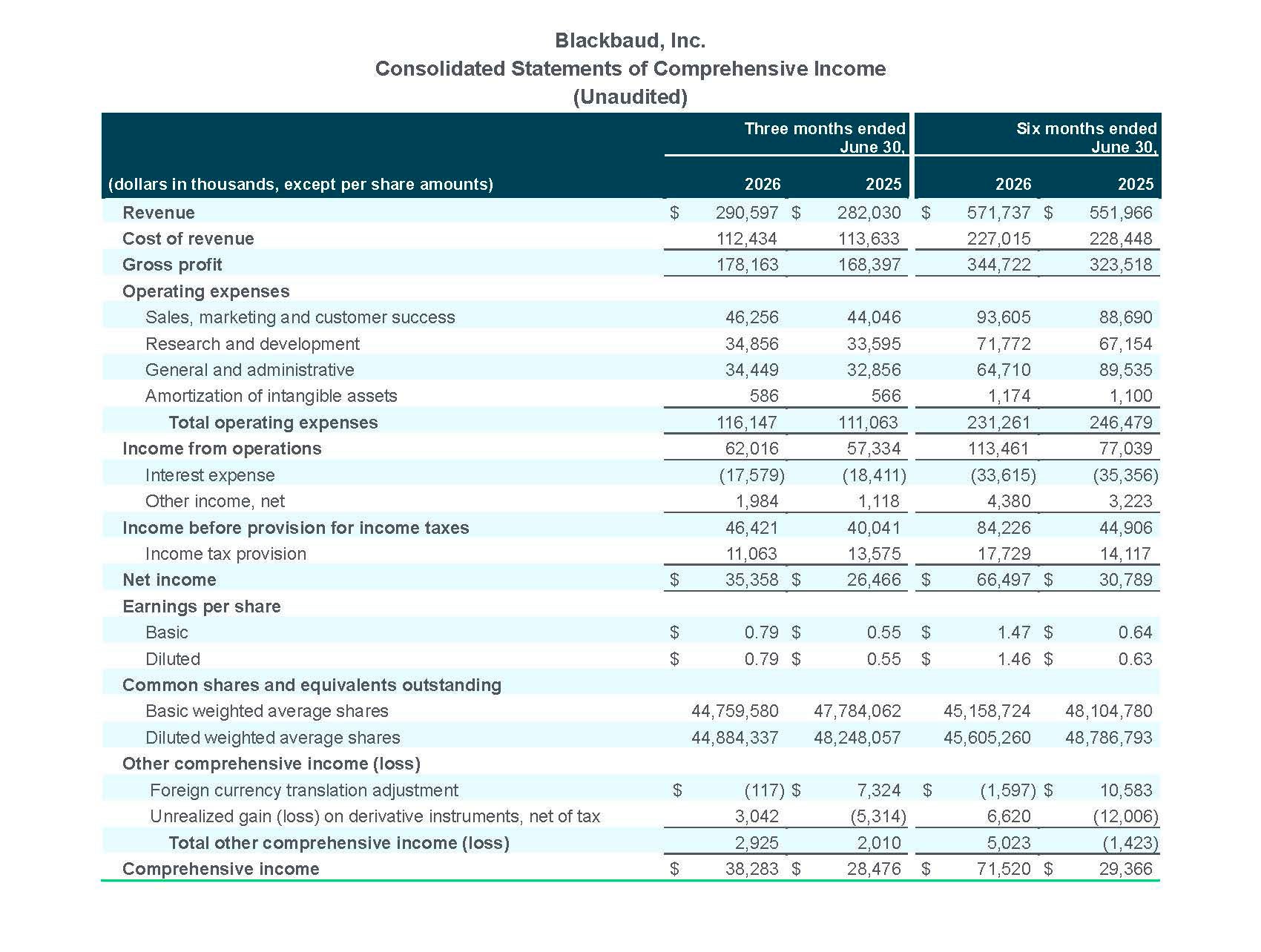
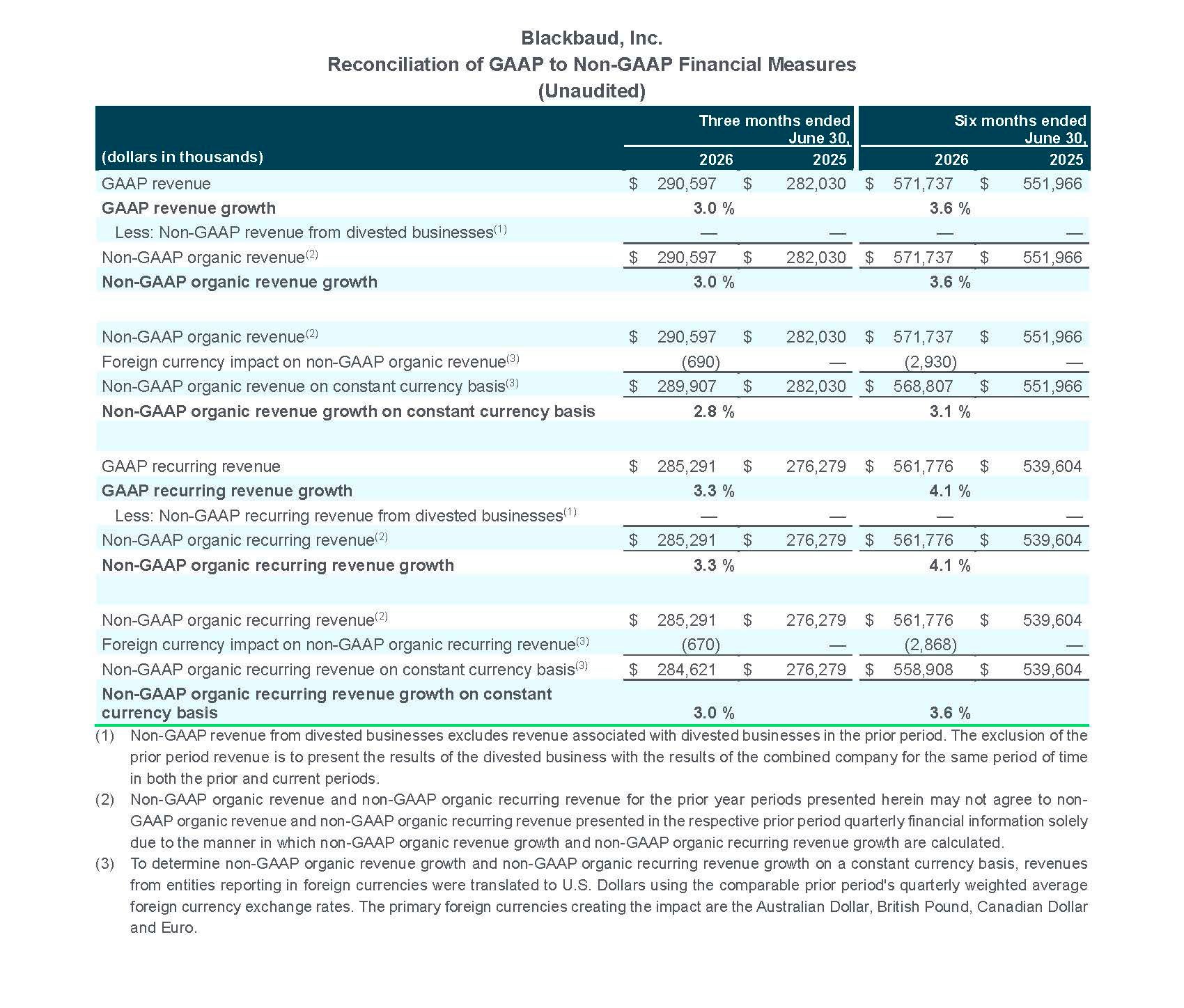
- GAAP total revenue was $290.6 million, up 3.0% and non-GAAP organic revenue increased 3.0%.
- GAAP recurring revenue was $285.3 million, up 3.3% and represented 98.2% of total revenue. Non-GAAP organic recurring revenue increased 3.3%.
- GAAP income from operations was $62.0 million, with GAAP operating margin of 21.3%, an increase of 100 basis points.
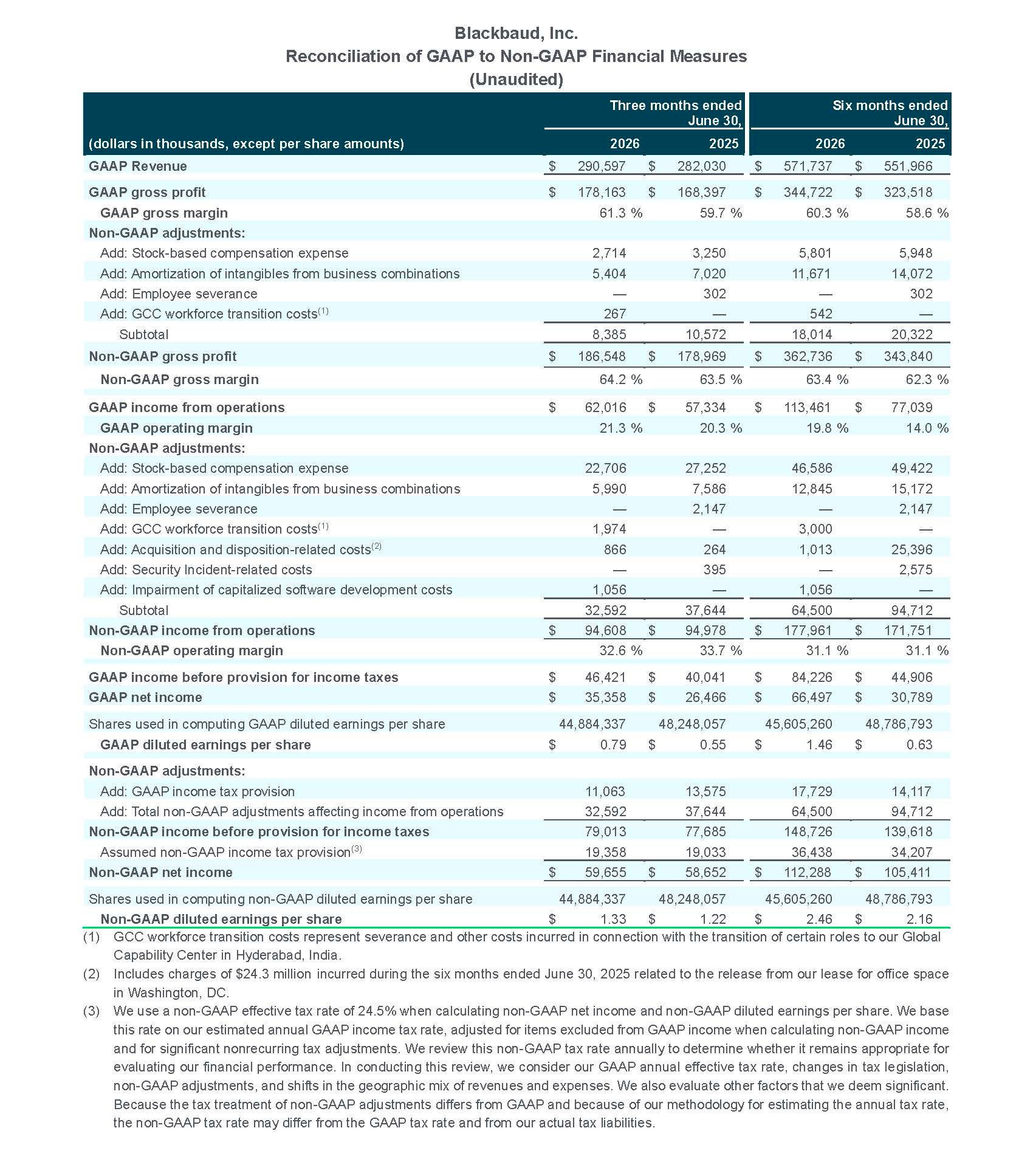
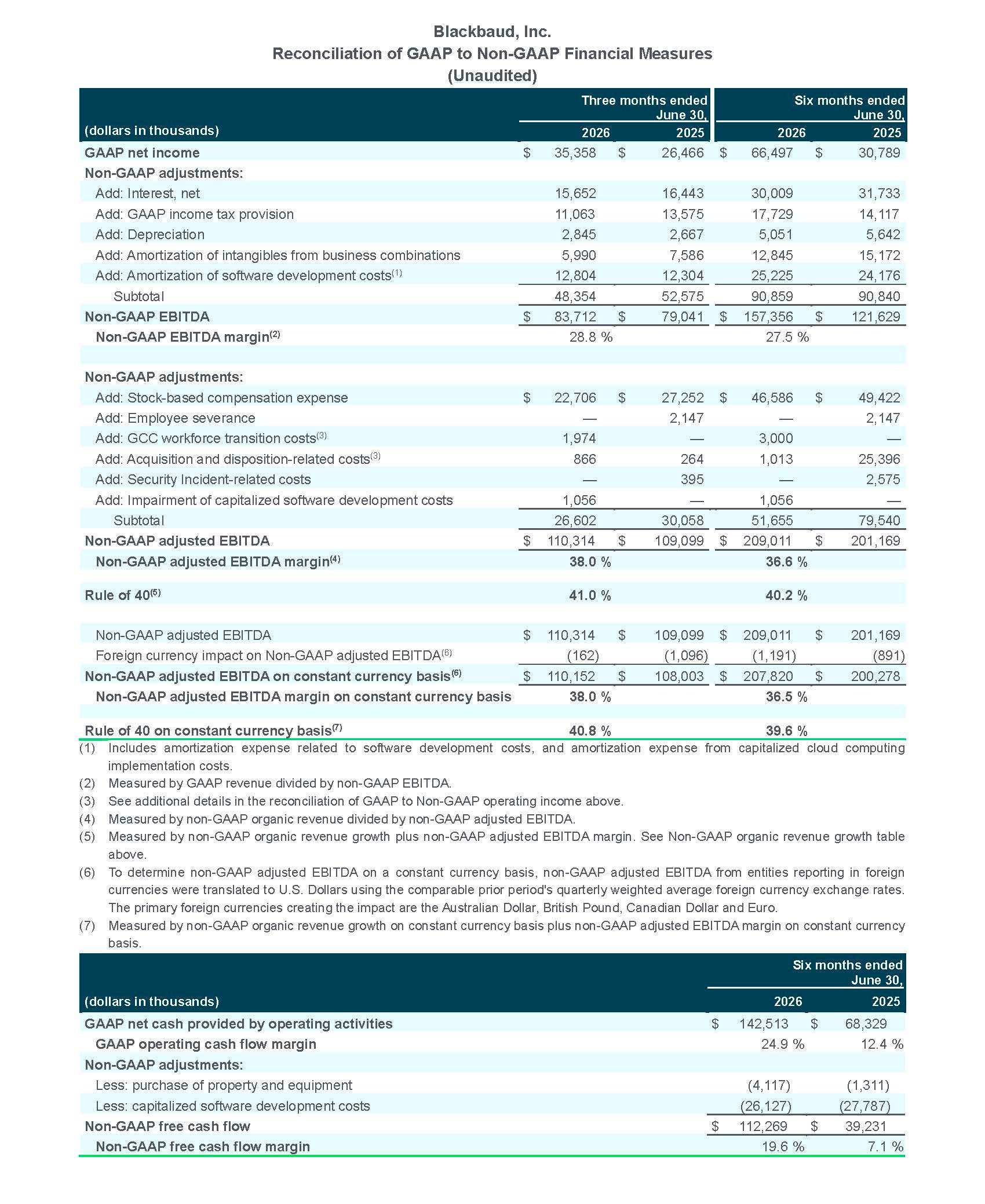
- Non-GAAP income from operations was $94.6 million, with non-GAAP operating margin of 32.6%, a decrease of 110 basis points.
- GAAP net income was $35.4 million, with GAAP diluted earnings per share of $0.79, up $0.24 per share.
- Non-GAAP net income was $59.7 million, with non-GAAP diluted earnings per share of $1.33, up $0.11 per share.
- Non-GAAP adjusted EBITDA was $110.3 million, up $1.2 million, with non-GAAP adjusted EBITDA margin of 38.0%, a decrease of 70 basis points.
- Rule of 40 score was 41.0%.
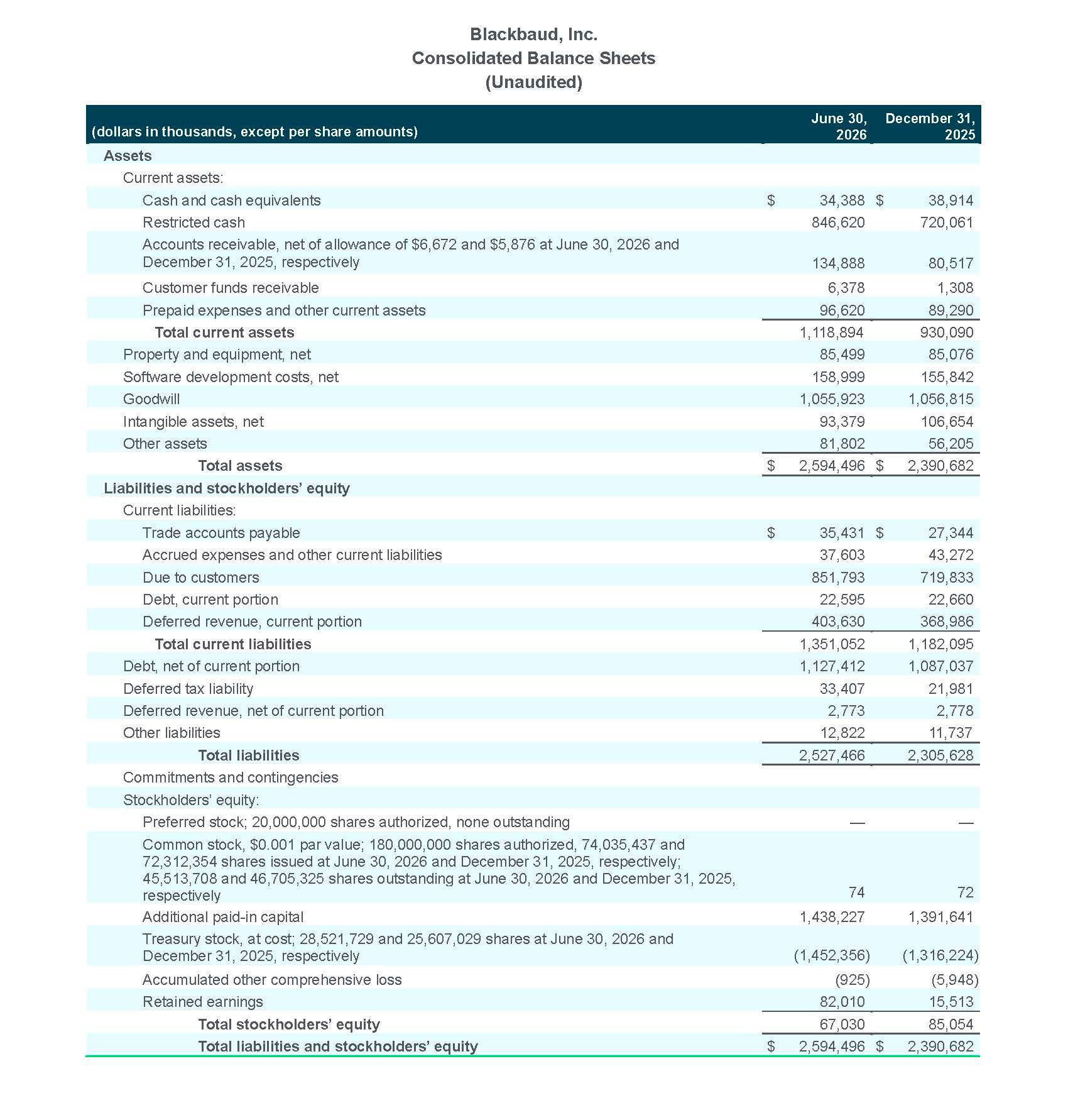
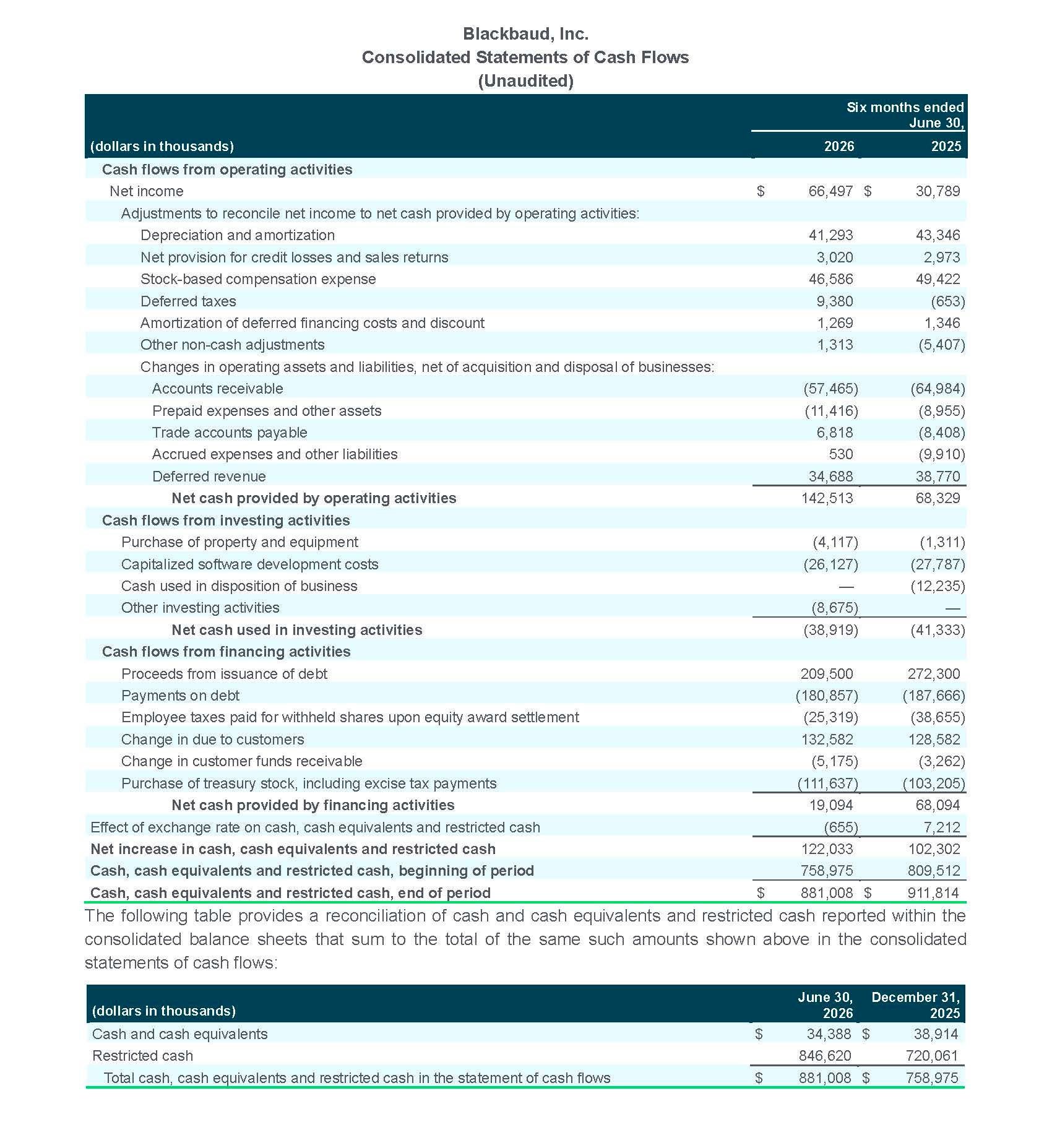
- GAAP net cash provided by operating activities was $91.1 million, an increase of $24.1 million, with GAAP operating cash flow margin of 31.3%, an increase of 760 basis points.
- Non-GAAP free cash flow was $75.3 million, an increase of $23.8 million, with non-GAAP free cash flow margin of 25.9%, an increase of 760 basis points.
“We again executed well against our operating plan while investing in innovation and efficiency across the business,” said Chad Anderson, executive vice president and CFO, Blackbaud. “We’re building the foundation for substantial shareholder value, supported by an attractive financial model and steady momentum toward our long-term goals. We also remain aggressive in repurchasing our shares having already repurchased just over 6% this year, reducing our total shares outstanding by approximately 15% since the fourth quarter of 2023.”
An explanation of all non-GAAP financial measures referenced in this press release, including the Rule of 40, is included below under the heading “Non-GAAP Financial Measures.” A reconciliation of the company’s non-GAAP financial measures to their most directly comparable GAAP measures has been provided in the financial statement tables included below in this press release.
Recent Company Highlights
- Blackbaud announced multiple new Agents for Good™ and AI-powered product enhancements planned as part of a reimagined cloud-native, AI-first connected platform, underscoring the company’s continued innovation momentum and differentiated position as the trusted AI engine for social impact.
- The Blackbaud Institute published research that shows that while AI adoption is accelerating across the social impact sector, the organizations seeing transformational results have higher levels of AI maturity, moving beyond fragmented experimentation to systemic, governed AI use. To support the long-term health of the sector, Blackbaud has convened the AI Coalition for Social Impact, which has launched a free certification program to equip professionals to adopt AI responsibly, confidently and effectively.
- At its bi-annual Product Update Briefings and annual bbdevdays Developers Conference, Blackbaud showcased continued product and platform innovation highlighting new AI-powered capabilities, expanded connected workflows, and developer tools that reinforce the company’s trusted AI engine strategy and help customers build, extend, and scale purpose-built solutions for social impact.
- Blackbaud strengthened its leadership in education, launching an Innovation Partnership and strategic investment in Student First to help higher education institutions build a more connected campus operating model, and unveiling new AI innovation for K–12 independent schools, including an Admissions Agent in development to help schools deliver more personalized, efficient admissions experiences.
- The company earned recognition from the American Business Awards for AI innovation and leadership, was named to Newsweek’s World’s Greenest Companies list for the second consecutive year, and was honored on the TIME America’s Best Companies 2026 list, underscoring continued momentum in responsible innovation, sustainability and workplace excellence.
- Blackbaud released its 2025 Impact Report, highlighting progress across responsible AI, sustainability and global social impact, reinforcing the company’s commitment to using purpose-built technology and responsible business practices to help customers and communities drive measurable outcomes.
Visit www.blackbaud.com/newsroom for more information about Blackbaud’s recent highlights.
Financial Outlook
- Blackbaud today reaffirmed its 2026 full year financial guidance and expects to finish in the upper half of the range across all four key metrics:
- GAAP revenue of $1.173 billion to $1.179 billion
- Non-GAAP adjusted EBITDA of $430 million to $438 million
- Non-GAAP diluted earnings per share of $5.15 to $5.25
- Non-GAAP free cash flow of $280 million to $290 million
Included in its 2026 full year financial guidance are the following updated assumptions:
- Non-GAAP annualized effective tax rate is expected to be approximately 24.5%
- Interest expense for the year is expected to be approximately $62 million to $66 million
- Diluted weighted average shares outstanding for the year are expected to be approximately 45.0 million to 46.0 million
- Capital expenditures for the year are expected to be approximately $60 million to $70 million, including approximately $52 million to $62 million of capitalized software development costs
Blackbaud has not reconciled forward-looking full-year non-GAAP financial measures contained in this news release to their most directly comparable GAAP measures, as permitted by Item 10(e)(1)(i)(B) of Regulation S-K. Such reconciliations would require unreasonable efforts at this time to estimate and quantify with a reasonable degree of certainty various necessary GAAP components, including for example those related to compensation, acquisition transactions and integration, tax items or others that may arise during the year. These components and other factors could materially impact the amount of the future directly comparable GAAP measures, which may differ significantly from their non-GAAP counterparts.
Stock Repurchase Program
As of June 30, 2026, Blackbaud had approximately $850 million remaining under its common stock repurchase program that was expanded, replenished and reauthorized in December 2025. Based on our current plans, and stock repurchases to date, we expect total repurchases during 2026 to represent between 6% and 10.0% of our outstanding common stock as of December 31, 2025.
Conference Call Details
What: Blackbaud’s 2026 Second Quarter Conference Call
When: July 29, 2026
Time: 8:00 a.m. (Eastern Time)
Live Call: 1-877-407-3088 (US/Canada)
Webcast: Blackbaud’s Investor Relations Webpage
About Blackbaud
Blackbaud (NASDAQ: BLKB) is the world’s leading provider of AI-powered solutions for social impact. Serving nonprofits, educational institutions, companies committed to corporate social responsibility and individual change makers, Blackbaud propels impact at scale with the sector’s most intelligent solutions for fundraising and engagement, education solutions, financial management and CSR and grantmaking. With the deepest expertise powered by the world’s largest philanthropic data set, the most connected workflows, and the most powerful impact network, Blackbaud’s solutions are building a future where resources are unleashed at the speed of need. Blackbaud has been recognized by Fast Company, Newsweek, Quartz, Forbes and more for AI innovation, responsible leadership and workplace excellence. Blackbaud has operations in the United States, Australia, Canada, Costa Rica, India and the United Kingdom, supporting users in 100+ countries. Learn more at www.blackbaud.com, or follow us on X/Twitter, LinkedIn, Instagram, and Facebook.
Investor Contact
Media Contact
Forward-Looking Statements
Except for historical information, all of the statements, expectations, and assumptions contained in this news release are forward-looking statements which are subject to the safe harbor provisions of the Private Securities Litigation Reform Act of 1995, including, but not limited to, statements regarding the predictability of our financial condition and results of operations. These statements involve a number of risks and uncertainties. Although Blackbaud attempts to be accurate in making these forward-looking statements, it is possible that future circumstances might differ from the assumptions on which such statements are based. In addition, other important factors that could cause results to differ materially include the following: management of integration of acquired companies; uncertainty regarding increased business and renewals from existing customers; a shifting revenue mix that may impact gross margin; continued success in sales growth; risks related to the development, deployment, regulation, security, market adoption and perception of artificial intelligence technologies; cybersecurity and data protection risks and related liabilities; potential litigation involving us; and the other risk factors set forth from time to time in the SEC filings for Blackbaud, copies of which are available free of charge at the SEC’s website at www.sec.gov or upon request from Blackbaud’s investor relations department. Blackbaud assumes no obligation and does not intend to update these forward-looking statements, except as required by law.
Trademarks
All Blackbaud product names appearing herein are trademarks or registered trademarks of Blackbaud, Inc.
Non-GAAP Financial Measures
Blackbaud has provided in this release financial information that has not been prepared in accordance with GAAP. Blackbaud uses non-GAAP financial measures internally in analyzing its operational performance. Accordingly, Blackbaud believes these non-GAAP measures are useful to investors, as a supplement to GAAP measures, in evaluating its ongoing operational performance and trends and in comparing its financial results from period-to-period with other companies in Blackbaud’s industry, many of which present similar non-GAAP financial measures to investors. However, these non-GAAP financial measures may not be completely comparable to similarly titled measures of other companies due to potential differences in the exact method of calculation between companies.
The non-GAAP financial measures discussed above exclude the impact of certain transactions that Blackbaud believes are not directly related to its operating performance in any particular period, but are for its long-term benefit over multiple periods. Blackbaud believes these non-GAAP financial measures reflect its ongoing business in a manner that allows for meaningful period-to-period comparisons and analysis of trends in its business.
While Blackbaud believes these non-GAAP measures provide useful supplemental information, non-GAAP financial measures should not be considered in isolation from, or as a substitute for, financial information prepared in accordance with GAAP. Investors are encouraged to review the reconciliations of these non-GAAP measures to their most directly comparable GAAP financial measures.
Non-GAAP free cash flow is defined as operating cash flow less capital expenditures, including costs required to be capitalized for software development, and capital expenditures for property and equipment. Blackbaud believes non-GAAP free cash flow provides a useful measure of the company’s operating performance. Non-GAAP free cash flow is not intended to represent and should not be viewed as the amount of residual cash flow available for discretionary expenditures.
In addition, Blackbaud uses non-GAAP organic revenue growth, non-GAAP organic revenue growth on a constant currency basis, non-GAAP organic recurring revenue growth and non-GAAP organic recurring revenue growth on a constant currency basis, in analyzing its operating performance. Blackbaud believes that these non-GAAP measures are useful to investors, as a supplement to GAAP measures, for evaluating the periodic growth of its business on a consistent basis. Each of these measures excludes incremental acquisition-related revenue attributable to companies, if any, acquired in the current fiscal year. For companies acquired in the immediately preceding fiscal year, each of these measures reflects presentation of full-year incremental non-GAAP revenue derived from such companies as if they were combined throughout the prior period. In addition, each of these measures excludes prior period revenue associated with divested businesses, if any. The exclusion of the prior period revenue is to present the results of the divested businesses within the results of the combined company for the same period of time in both the prior and current periods. Blackbaud believes this presentation provides a more comparable representation of its current business’ organic revenue growth and revenue run-rate.
Rule of 40 is defined as non-GAAP organic revenue growth plus non-GAAP adjusted EBITDA margin. Non-GAAP adjusted EBITDA is defined as GAAP net income plus interest, net; income tax provision (benefit); depreciation; amortization of intangible assets from business combinations; amortization of software development costs; stock-based compensation expense; Global Capabilities Center (“GCC”) workforce transition costs; acquisition and disposition-related costs; and Security Incident-related costs.